Phase 1: Thermal Mapping and Moisture Detection
Using FLIR infrared cameras, Tramex CME5 concrete meters, and insulated deep-wall pin probes, we map the moisture in your slab, subfloor, baseboards, and cabinets before anything is removed.
24/7 Emergency Response · Arizona
Arizona Slab Leak Cleanup connects you with IICRC S500 certified technicians who respond fast across Arizona to extract water, dry saturated concrete slabs, rescue wet floors and cabinets, and produce the thermal moisture documentation your HO-3 homeowners insurance claim needs. Call (480) 863-0799, 24 hours a day.
24-Hour Arizona Emergency Line: (480) 863-0799 Free on-site thermal moisture inspection | No referral fees | Direct insurance billing through Xactimate
Important Insurance Note: Call Before Floors Are Torn Out. Many Arizona HO-3 policies cover tear-out, drying, and floor replacement after a sudden pipe leak. The strongest claims are backed by thermal images and moisture readings taken before demolition starts. If floors are jackhammered or wet materials are hauled away first, or if the leak is reported as "slow seepage," adjusters may reduce or deny the floor and cabinet portion of the claim. Call (480) 863-0799 first for a free emergency thermal inspection.
24-hour emergency response · Serving all of Arizona
Before the restoration crew arrives, take these five steps to stay safe, limit damage, and protect your insurance claim:
Arizona's hard water, chloramine-treated supply, and high street pressure wear down copper and older polybutylene pipes buried beneath concrete slabs, so indoor water emergencies happen in every season, not just during storms.
Indoor plumbing failures happen as often in January as they do in July. The large majority of Arizona single-family homes, townhomes, and active-adult villas across Maricopa, Pima, Pinal, Yavapai, Mohave, and Coconino counties are built on slab-on-grade concrete foundations, either standard monolithic slabs or post-tensioned slabs (often stamped "POST-TENSIONED SLAB - DO NOT CUT OR CORE" in the garage).
Under these 4 to 6 inch slabs, copper or PEX water lines are buried against alkaline desert soil, caliche, and sharp fill. Three year-round stresses cause them to fail without warning:
| Home Era / Region | Plumbing and Foundation | Most Common Failure | IICRC S500 Category / Class and Priority |
|---|---|---|---|
| 1978-1995 subdivisions (Mesa, Glendale, Peoria, Tucson, Sun City West, Green Valley) | Gray polybutylene (PB2110) and uninsulated copper under monolithic slabs | Chlorine-related flaking and sudden pipe splits under slabs and in manifold walls | Category 1-2 / Class 2-3: fast extraction, baseboard relief, LGR drying |
| 1996-2012 master-planned communities (Gilbert, Chandler, Scottsdale, Surprise, Avondale, Marana) | Type M / Type L copper in alkaline soil under post-tension slabs | Hard water and chloramine pitting causing hot-water pinhole leaks | Category 1 / Class 4: thermal slab mapping, LVP removal or mat drying, LGR/desiccant drying |
| Foothill and hillside estates (Paradise Valley, Cave Creek, Fountain Hills, Catalina Foothills, Sedona, Prescott) | High-pressure zones with copper manifolds and wood or stone floors | Failed PRVs bursting toilet lines, ice makers, and water heaters | Category 1 / Class 3-4: hardwood and stone mat drying, cabinet cavity drying |
| Two-story family homes, 2005-2026 (Queen Creek, San Tan Valley, Buckeye, Goodyear, Vail, Sahuarita) | Upstairs laundry rooms and baths over I-joist floor cavities | Washer hose and shut-off valve failures leaking into first-floor ceilings | Category 1-2 / Class 3: ceiling drainage, insulation removal, multi-level drying |
| 55+ and seasonal homes (Sun City, Oro Valley, Florence, Bullhead City, Lake Havasu, Casa Grande) | Homes left empty for months with RO filters and water softeners | Unnoticed RO housing cracks and softener overflows running for days | Category 2-3 / Class 3-4: HEPA containment, decontamination, deep slab drying |
When a pipe bursts under an Arizona slab, water fills the sand bed beneath the concrete and pushes upward through cracks and pipe openings, getting trapped under tile, LVP, and hardwood where it cannot evaporate.
Many homeowners, and even some plumbers, assume a wet slab will "dry out on its own" in the desert heat once the pipe is fixed or rerouted. In reality, that rarely happens:
| Material | Saturated Reading | Dry Standard (Arizona) | Drying Method |
|---|---|---|---|
| Concrete slab (monolithic or post-tension) | Above 4.5% CM (above 85% in-slab RH) | Below 3.5-4.0% CM (below 75% RH per ASTM F2170) | Tramex CME5 meter, LGR dehumidifiers, targeted heat |
| Wood sill plates and studs | Above 20% MC | 6-10% MC (within 2% of unaffected framing) | Delmhorst pin meter, wall cavity injection |
| Gypsum drywall | Above 1.5% WME or wicked above 12 inches | Below 0.8% WME | Hidden baseboard relief holes or flood cuts, air movers |
| Kitchen and bath cabinets | Above 18% MC in toe-kick | 7-10% MC | Injectidry HP60 toe-kick cavity drying |
| Room air (psychrometrics) | Above 65 GPP (above 60% RH) | Below 35 GPP (25-35% RH at 80-88°F) | Commercial LGR dehumidifiers |
Every job follows the IICRC S500 Standard for Professional Water Damage Restoration (iicrc.org/s500), using thermal imaging, water extraction, floor and cavity drying systems, and low-grain refrigerant (LGR) dehumidification to bring concrete and framing back to verified dry standards.
We do not guess where moisture is hiding, and we do not just drop off box fans. Each job follows six phases:
Using FLIR infrared cameras, Tramex CME5 concrete meters, and insulated deep-wall pin probes, we map the moisture in your slab, subfloor, baseboards, and cabinets before anything is removed.
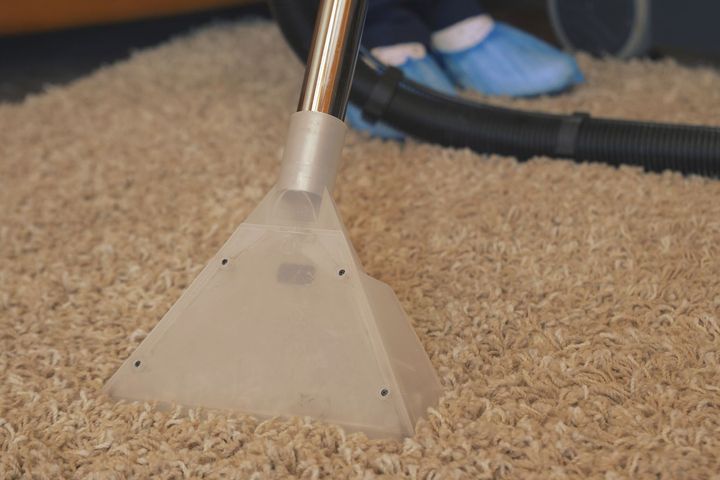
Removing water physically is far faster than evaporating it. For carpet and pad, we use weighted extraction tools that press water out against the slab. For hard floors, we use truck-mounted vacuums and squeegee wands to clear standing water from concrete and grout lines.
When hardwood, tile, or cabinets have absorbed clean (Category 1) water, we use negative-pressure floor mats (Injectidry HP60) and wall and toe-kick injection systems. Instead of tearing out expensive custom cabinets or entire tile floors, we drill small hidden ports behind the baseboard or toe-kick and push warm, dry air across the wet concrete and framing.
To pull deep moisture out of a 4-inch slab (Class 4 water), the air in the drying area must be very dry. We set up 6-mil plastic containment around affected areas only and run commercial LGR dehumidifiers (such as the Dri-Eaz LGR 7000XLi or Phoenix DryMAX XL) with angled air movers.
Water trapped under floors or inside warm Arizona walls can turn from clean (Category 1) to gray (Category 2) water within 24 to 48 hours. Following EPA mold guidance (epa.gov/mold) and IICRC S520, we run HEPA air scrubbers when needed and treat exposed framing and concrete with EPA-registered antimicrobials.
Every 24 hours, your technician records temperature, humidity, grains per pound (GPP), dehumidifier performance, and moisture readings at marked points. Equipment comes out only when your slab and framing reach Arizona dry standards (6-10% for wood and drywall, below 4.0% CM for concrete). You receive a signed IICRC S500 Certificate of Dryness for your records and your flooring installer.
| Situation | Typical Scope | Estimated Range* | Typical HO-3 Coverage |
|---|---|---|---|
| Appliance or supply line leak (1 room) | Shut-off, extraction, baseboard relief, 3 air movers + 1 LGR (3 days) | $1,250 - $2,850 | Often covered under Coverage A above the deductible for sudden leaks |
| Burst water heater (garage or utility room) | 50-80 gallon extraction, shared wall drying, wet insulation removal, antimicrobial | $1,850 - $4,600 | Water damage and drying often covered; tank replacement usually not |
| Single-area under-slab pinhole leak | Thermal mapping, selective flooring removal, slab drying, HEPA containment | $2,800 - $6,900 | Tear-out, drying, and flooring often covered for sudden discharge |
| Multi-room slab leak or cabinet saturation | Large-area extraction, cabinet toe-kick drying, LGR/desiccant slab drying, daily logs | $4,900 - $11,800+ | Often covered when supported by moisture and thermal documentation |
| Upstairs laundry or pipe burst into ceilings | Multi-level extraction, ceiling stabilization, joist cavity drying, HEPA scrubbing (4-6 days) | $5,400 - $14,500+ | Often covered under Coverage A (Dwelling) and Coverage C (Personal Property) |
Pricing disclaimer: These figures are rough educational estimates for Arizona residential water damage based on 2026 regional Xactimate averages. Actual costs depend on affected square footage, water category (1, 2, or 3), materials, and drying time. Coverage depends on your individual policy. Calling (480) 863-0799 connects you, at no charge, with an independent certified restoration contractor serving your ZIP code, who provides an on-site inspection and written estimate before work begins.
Most Arizona HO-3 policies do not pay for repairing the failed pipe itself, but many do cover the resulting water damage, including tear-out to reach the leak, structural drying, and rebuilding floors and cabinets, when the loss is sudden and well documented.
One of the most costly mistakes homeowners make is starting demolition or filing a claim before a certified restoration technician documents the moisture. Here is what usually decides whether a claim is approved:
A warm patch on tile, laminate, or LVP along with a faint hissing sound usually means a hot-water line is leaking under your concrete slab. Shut off your main water valve and call (480) 863-0799 for thermal moisture mapping before the flooring buckles.
Call a restoration team at (480) 863-0799 first, or at the same time as your leak detection plumber, before any concrete is broken or a claim is filed. Thermal photos and moisture readings taken before demolition help support your HO-3 claim for tear-out and drying.
Usually not. Water trapped under tile, LVP, carpet pad, or inside insulated walls gets almost no airflow, no matter how hot it is outside. Without commercial LGR dehumidifiers and extraction, trapped moisture can warp flooring and lead to mold within 24 to 48 hours.
Many standard HO-3 policies cover sudden, accidental water damage from a slab leak or burst pipe, including extraction, drying, and tearing out and replacing floors or cabinets to reach the pipe. The pipe repair itself is usually excluded. Always confirm with your own policy.
Most burst pipe and appliance floods reach IICRC S500 dry standards (6-10% wood moisture) in 3 to 4 days. Deep slab saturation involving concrete, hardwood, or cabinets (Class 4) typically takes 4 to 7 days of monitored drying.